


Your Guide to the 2026 Vaud Municipal Elections Part II

Updated: Apr 19
How to fill in your ballot without second-guessing yourself
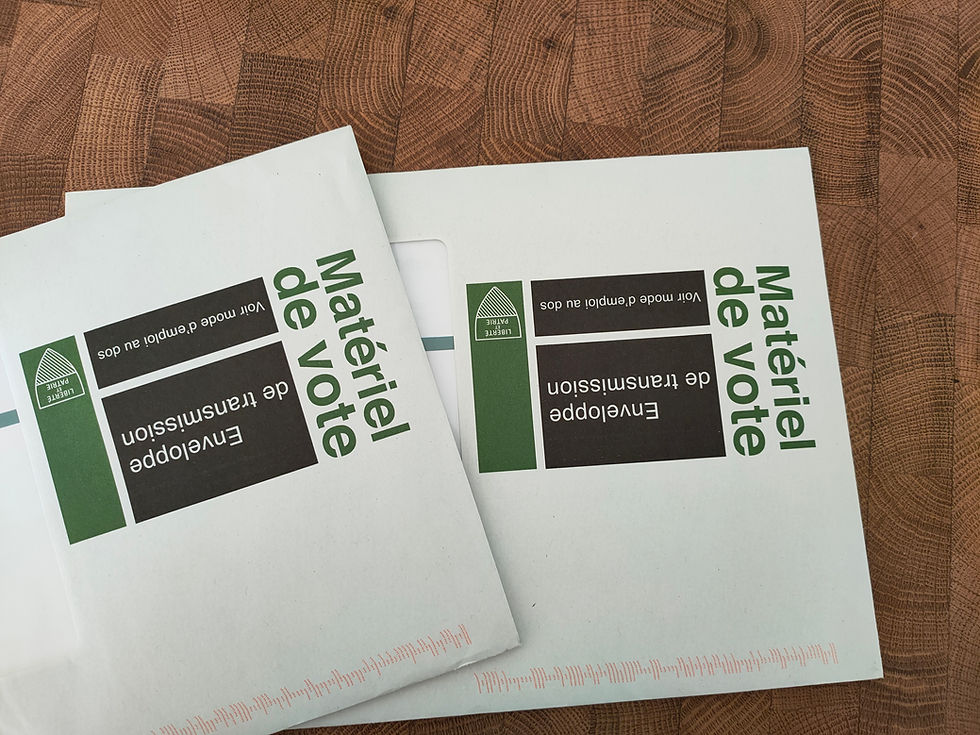
By now, your voting envelope may already be sitting on the kitchen table. Inside: multiple ballots, party lists, blank lines, and instructions that can feel... a little overwhelming at first glance. If you’ve ever opened a Swiss voting envelope and thought, “Right. Let me have a coffee before I tackle this.” (Definitely me.) You’re not alone.
In Part I, we covered who can vote and the key dates for this spring’s municipal elections. In Part II, Bob Jenefsky walks us through the practical side: how to actually complete your ballot for the Nyon City Council and Municipalité without accidentally invalidating your vote.
It’s not as complicated as it looks once you understand the logic behind it. Here’s how it works.
Living in Nyon holds no affiliation with any political party. We offer space for candidates to share their perspectives for our readers.
What’s in your voting envelope?
If you are entitled to vote in the next round of municipal elections on Sunday, March 8, you will already have received your voting envelope. Inside, you’ll find slightly different materials depending on your status.
If you are Swiss, your envelope includes:
A booklet of ballots for the election to the Nyon City Council
A ballot for the first round of the election to the Nyon government (Municipalité)
A ballot for the cantonal by-election of a member of the cantonal government (Conseiller·ère d’Etat)
A ballot for the federal referendum
Official explanatory brochures
If you are a non-Swiss resident eligible to vote, you will receive:
The ballots for the Nyon City Council
The ballot for the Nyon Municipalité
In the sections below, we’ll focus on how to complete the two Nyon municipal ballots.
Nyon City Council Election
On March 8, voters will elect all 100 members of the Nyon City Council in a single go. This election is based on proportional representation. In simple terms, each party receives the number of seats that reflects its share of the total votes cast.
Each voter has 100 votes (called “suffrages”) to distribute, corresponding to the 100 seats to be filled.
In your envelope, you’ll find:
7 numbered ballots (one for each party, see table below)
1 unnumbered ballot with 100 blank lines

Here’s how it works.
Option 1: Vote for one party list as it stands
You can give all 100 of your suffrages to a single party by simply placing one of the printed party ballots in the envelope without making any changes.
In that case:
The party receives 100 suffrages.
Each candidate on that list receives one suffrage.
Option 2: Support specific candidates on a party list
If you are using a printed party ballot, you can personalise it slightly.
You may:
Write a candidate’s name a second time (but not a third). That candidate will receive two suffrages.
Cross off the names of candidates you do not wish to support.
In both cases, the party still receives 100 suffrages in total.
How seats are allocated
After voting closes on March 8, all suffrages are counted. Each party’s total suffrages are compared to the overall number of suffrages cast. Seats are then distributed proportionally.
For example, if a party receives 22% of the total suffrages, it will receive 22 of the 100 seats.
Once this has been established, the number of votes per candidate is tallied to determine which of the candidates actually get the seats, beginning with the candidate with the most suffrages.
What if you want to vote across party lines?
If you like candidates from more than one party, you have two options.
Option 1: Use the blank ballot
You can take the blank ballot and write in up to 100 candidate names by hand (including candidates whose names you’ve entered twice).
A few important rules apply:
You may only vote for official candidates (those listed on the 7 printed party ballots).
Each party receives one suffrage for each of its candidates you include.
If you list fewer than 100 names, you may also write the name and number of a single party in the upper right-hand corner of the ballot. That party will then receive the remaining suffrages needed to bring your total to 100.
For example, if you write in 60 candidate names and indicate a party in the corner, that party will receive the remaining 40 suffrages.
Option 2: Start with a printed party ballot and modify it
You may also begin with one of the printed party ballots and then add candidates from other parties.
In this case:
For every candidate you add from another party, one suffrage is deducted from the 100 originally allocated to the party whose printed ballot you are using.
The added candidate receives one suffrage for their own party.
Important reminder
Place only one City Council ballot in the envelope. Including more than one will disqualify your vote.

Election to the Nyon Municipalité (First Round)
The election to the Municipalité works differently from the City Council vote.
This is a majority election, not a proportional one. You will receive a single ballot listing the candidates. You may select up to seven candidates, as there are seven seats to be filled.
Important rules:
You may not choose more than seven candidates.
You may not write a candidate’s name twice.
If you select more than seven names, your ballot will be disqualified.
In this first round, candidates obtaining the absolute majority of votes cast are elected.
If not all seven seats are filled in the first round (which is often the case), a runoff election will take place on Sunday, March 29, and the remaining seats will then be decided by relative majority.
Be an informed voter!
If you’d like to learn more about the parties and candidates standing in Nyon, you can find profiles and official information on the City of Nyon website at www.nyon.ch.
Party representatives are also present on Saturday mornings at Place St-Martin. It’s an opportunity to ask questions, exchange views, and, yes, occasionally pick up a bit of cool swag along the way.
Municipal elections shape everyday life in Nyon, from local schools and public spaces to transport and community services. Taking a few minutes to understand how your ballot works helps ensure your vote reflects your intentions.
Happy voting on March 8.
Robert (Bob) Jenefsky is an elected member of the Nyon City Council and president of the
Parti Indépendant Nyonnais (www.independant.ch) . He is also co-founder of Nyon
Business Forum, a business networking group established in 2017 (www.nyonbusinessforum.ch). Bob holds a PhD in Physics from the Swiss Federal Institute
of Technology, Lausanne (EPFL).


Comments